
Abstract
In this research paper, I draw on Edward Said’s concept of Orientalism to examine the history of Grinnell-in-China, a missionary program initiated and funded by Grinnell College from 1912 to 1941[1] in partnership with the American Board’s[2] North China Mission.[3] This program funded Porter-Wyckoff Middle,[4] a comprehensive English language school for boys and girls in Dezhou[5] in the Shandong Province of China as well as three teaching posts at Shantung Christian University.[6] The missionaries saw themselves as fighting back against British and Japanese imperialism in China,[7] yet ironically their inability to divorce themselves from an Orientalist understanding of China ended up making them complicit in, or even the primary agents of, the promotion of cultural imperialism.[8] I argue that while Grinnell-in-China was motivated by genuine humanitarian anti-imperialist impulses, the Grinnell missionaries in practice used their humanitarian work to attempt to control and mold the Chinese recipients of their aid in a project of cultural imperialism[9] that was based on a profoundly Orientalist understanding of Chinese culture.
Introduction
The American missionary effort in China was one of the largest programs of cultural exchange ever undertaken by this nation. Commencing in the nineteenth century with the innumerable missions launched by American churches, youth organisations, and schools, the American mission continues to influence our interactions with China to this day. In this article, I intend to examine the history of Grinnell-in-China, a missionary program initiated in 1912 by Grinnell College, a small historically Congregationalist college in Iowa, and funded by this institution in partnership with the American Board’s[10] North China Mission[11] until 1941.[12] This program funded Porter-Wyckoff Middle[13], a comprehensive English language school for boys and girls in Dezhou[14] in the Shandong Province of China as well as three teaching posts at Shantung Christian University.[15] The missionaries saw themselves as fighting back against British and Japanese imperialism in China,[16] yet ironically, they would be remembered by scholars primarily as agents of cultural imperialism.[17] I will argue that while Grinnell-in-China was motivated by genuine humanitarian anti-imperialist impulses, the Grinnell missionaries in practice were unable to separate themselves from an understanding of Chinese culture rooted in the discourse of Orientalism.[18] Grinnell-in-China’s humanitarian work ended up as an attempt to control the Chinese recipients of their aid and mold them in a project of cultural imperialism.[19]
Most of the foundational scholarship about American mission schools in China was written by the missionaries themselves, and includes works such as Seventy-Five Years of the North China Mission by missionary Harold S. Matthews.[20] These works have since been re-evaluated, with most modern historians viewing their notably uncritical, and at times hagiographical, depiction of the missionaries’ role in China with scepticism. More recent scholarship on the subject can be divided roughly into two camps. One group, building on the work of Gael Norma Graham[21] and exploring under the rubric of cultural imperialism, has focused on the ways in which American mission schools attempted to Westernise their students in China-wide studies seeking to examine the entire missionary school system at once. This contrasts with the second camp, which has followed the path of Kathleen L. Lodwick in works such as Educating the Women of Hainan: The Career of Margaret Moninger in China, 1915-1942[22] in creating case studies of specific missionary academies, hoping to tease out the kind of unique historical insights and details that come from focusing on a single location. In both schools, Edward Said’s concept of Orientalism is relevant, providing an imperfect[23] but useful[24] methodological tool, yet under-referenced,[25] present mostly in an implicit manner in criticisms of Western understandings of China. In this article, I attempt to bridge these camps via a focused case study that adopts the more critical lens of Gael Norma Graham’s work, while making use of Said’s concept of Orientalism to lay bare the limits of Graham’s use of cultural imperialism as a framework for analysis.
History of the Grinnell-in-China Mission
Initially, China was not a major focus of American missionary efforts. The American Board of Commissioners for Foreign Missionaries,[26] America’s predominant Protestant missionary organization, at first directed its resources toward India and the Levant.[27] China became a focus of American efforts in the late nineteenth century[28] after the Qing had been forced to open the nation to outsiders through the unequal treaties.[29] The American Board sent its first missionary into China, Rev. Elijah C. Bridgeman, in 1829,[30] founding its first North China mission station in Tianjin[31] on September 28, 1860.[32] The Dezhou mission station[33] was founded in Pangchuang[34] in 1880[35] in response to a severe famine in the local area: what had begun as an outpost for distributing humanitarian aid was later converted into a formal mission station.[36] In total, the American Board’s North China mission consisted of seven mission stations,[37] each of which began to establish schools to educate the local Chinese.[38] These schools aimed not only to boost local conversion but also to provide the backbone for a missionary school system, with Christian primary schools sending students to missionary boarding schools, who would in turn send their best and brightest to the missionary universities.[39] In order to alleviate the financial and logistical burden of providing a comprehensive western education in China, mission stations began partnering with small denominational colleges who would provide staff and funding for these schools, beginning with Oberlin-in-China in 1882.[40] The Dezhou Mission station would follow in 1912,[41] partnering with Grinnell College to inaugurate Grinnell-in-China.
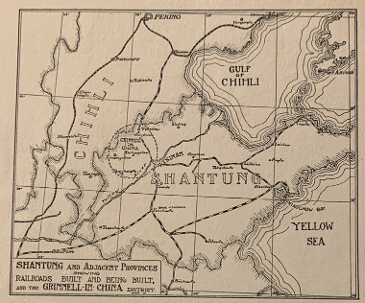
Figure 1. Map of North China with the Grinnell-in-China Mission compound circled and labelled. “The Grinnell-in-China educational movement,” pamphlet, 3, in box 56, folder P5, GiC
The Grinnell-in-China project was launched under the leadership of A.B. DeHaan at the height of America’s missionary fervor.[42] That the Dezhou station would partner with such a small college was not as odd as it seems, as small Midwestern denominational colleges[43] provided the majority of missionary volunteers,[44] and Grinnell was following in the footsteps of Yale[45] and Oberlin[46] in sponsoring a collegiate mission. The plan was for Grinnell to raise funds and personnel to fully run Porter Middle School for Boys, partially support the Grace Wyckoff Memorial School for Girls, and provide three teachers for Shantung Christian University.[47] Grinnell was to do this under the aegis of the American Board of Commissioners for Foreign Missionaries (ABCFM), which ran the Dezhou mission compound where the schools were to be located, and in equal partnership with the Grinnell Congregational Church.[48] This project was embraced enthusiastically by the Grinnell College community as a continuation of the ‘Grinnell Spirit’ of humanitarian service[49] that was thought to have motivated the initial founding of Grinnell College by the ‘Iowa Band’ of eleven missionaries from Massachusetts.[50] Indeed, by 1916,[51] a group of missionaries named the ‘Grinnell-in-China Band’[52] had reached China.[53]
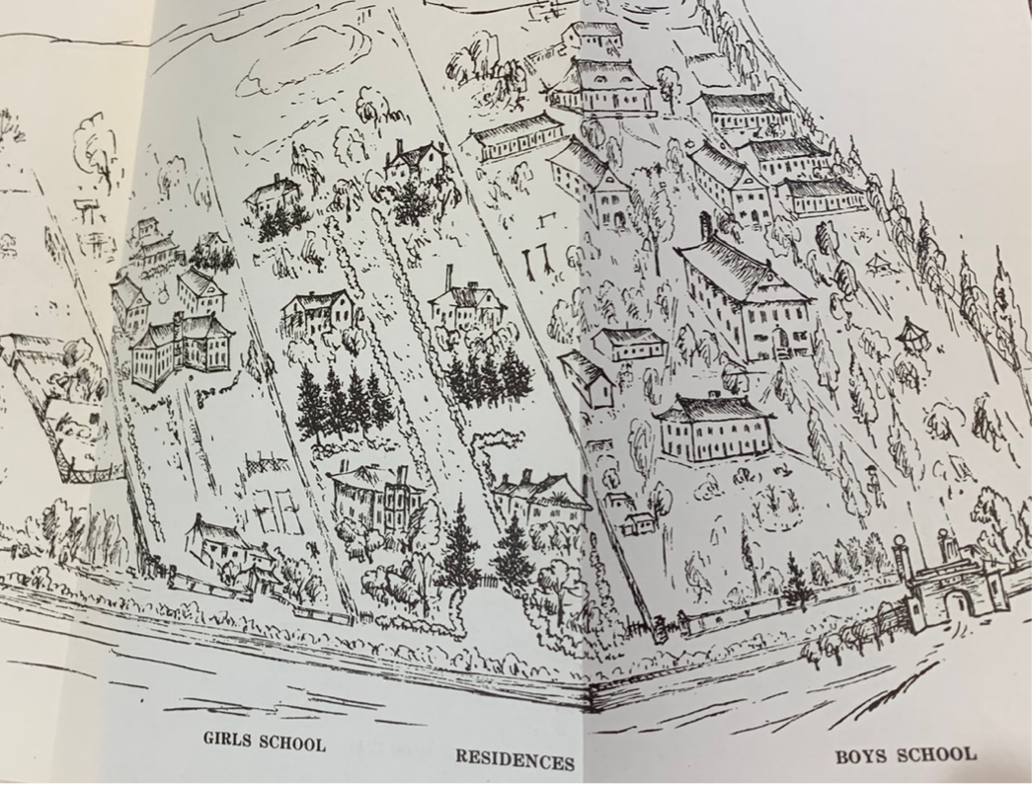
Figure 2. Drawing of the Wyckoff School for Girls and the Porter School for Boys. Dr. Fritz Baumgarten, “Mission Station Techow,” page 5, 1940, Collection Identifier bms 1003, Box 17, Folder 19, Divinity Papers.
Grinnell-in-China was a missionary project motivated by the desire to spread Christianity to the Chinese. The missionary origins of the project can be seen in its administration through the American Board, the (intended) equal partnership with Grinnell Congregational Church,[54] and also in the fact that the fundraising for it was conducted via a chapel service.[55] The evangelical motive was made explicit when a founding a member of the Grinnell-in-China band wrote to American donors requesting $10,000 for bibles[56] and stated that the purpose of their mission was ‘to teach [the Chinese] the gospel of Christ.’[57] The central role of evangelism was even clearer in an official mission report, which stated that the purpose of the mission hospital’s was ‘not to relieve the suffering of those who apply… but to make it subservient to the larger purpose of awakening an interest in the Gospel.’[58] The missionaries, as it were, intended to create a Christian China.
Moreover, the Grinnell-in-China mission was charged with an additional purpose: it intended to disseminate Christian Democracy[59] in East Asia. The two-fold goal of the mission transparently reflected a vision that was firmly rooted in what Edward Said called Orientalism, in that it not only tried to shape the East in the form of America, both in spiritual essence and in governing structure, but also unquestionably assumed the superiority of Christianity and democracy and viewed them as things that needed to replace what was then present in China. The Grinnell-in-China mission understood China’s poverty and international weakness to be products of its inferior culture. Grinnell’s humanitarianism thus found the cause of the economic stagnation and suffering of the Chinese in their civilizational backwardness or wrongness and saw it as its duty to train Chinese leaders and youths in Western beliefs and Western ways of governance so that those who had been educated by the mission would improve the lives of the Chinese masses and elevate Chinese culture to a place on the world stage equal to those of its Western counterparts. It was in this context that the Grinnell Spirit,[60] which demanded that Grinnellians work to serve the needs of others, was most frequently invoked. In other words, the primary mission of Grinnell-in-China was to use Western education to produce new leaders for China,[61] men and women who could strengthen their country and lead it in resisting Japanese and Western imperialism alike.[62] In doing so, the missionaries saw themselves as anti-imperialist agents. This can be seen in a 1925 statement, signed by 109 of the 134 missionaries of the North China Mission, calling for ‘the modification of all treaties which infringe on the sovereignty or hinder the progress of China’[63] and specifically demanding ‘the withdrawal of the privileges of extra-territoriality granted to foreign residents.’[64] The fact that American missions believed that humanitarian education was the primary means of achieving the goal of improving the lot of poor Chinese can be seen in letters sent from China by Alice Reed, a member of the Grinnell-in-China mission, to her family members. In one example, she writes that ‘I felt a real desire to help the girls of the newly established Republic of China.’[65] Another American humanitarian, Emma Tucker, M.D., described herself as ‘eager with a humble but sacred longing to give to their less fortunate brothers and sisters something of all they had received.’[66] It would be fair to say that the missionaries genuinely wanted to help the Chinese and strengthen their nation.
Upon closer examination, we can see that the Grinnell-in-China project emerged from a complex mix of goals. It was intended to help the Chinese people, to train leaders who would fight against imperialism, to convert the country to Christianity, and to make China a Western, Christian democracy. Over the project’s lifespan, the compromises these different goals required would lead the missionaries to provide humanitarian aid during repeated famines[67] on the one hand and attempt to use that aid to eradicate the Chinese slothfulness that they perceived on the other. This approach, in which Chinese practices were seen as slothful, was widely shared by the American missionaries and aid agencies on the ground, one example being the Red Cross’s decision to focus its aid strictly on work relief programs.[68] The Grinnell-in-China project wanted to overcome such perceived Chinese shortcomings through education by incorporating efforts to eliminate students’ “inferior” practices within a structured academic pathway to higher education in the province of Shandong,[69] one of the few such pathways available in the region.[70] At the same time, the complex goals of the project would require the team to be creative at times, leading them, for example, to open up their leadership committee seats to Chinese Christians in an attempt to collaborate with the local population while they remained financially dependent[71] on America until the termination of the program in 1946.[72] In the following section, I look closely at the actual education content of the Grinnell-in-China project-funded schools.
A Western Education
At the time of its founding, Grinnell-in-China was focused on supporting and administering two schools for Chinese youths in Dezhou, Shandong Province, China: Porter Middle School for Boys and the Grace Wyckoff Memorial School for Girls.[73] The lack of education opportunities in China had created a huge void, and the missionaries were justifiably proud of filling that need. Porter Middle was ‘the only junior and senior high school [for students aged 11-18] in thirty-two counties with a population of more than five million.’[74] Wyckoff, meanwhile, as a grammar and junior high school (for students aged 5-14) for girls, filled an even greater need, as educational opportunities for women were even more limited than those for men.[75] The two schools were segregated by sex, although they would later be merged into a single, co-educational institution, Porter-Wyckoff, in 1929[76] in order to provide the female students with a higher grade level education while allowing for the conservation of resources.[77] These were fee-charging residential boarding schools that tended to attract relatively well-off students, with such fees covering seventy per cent of the total budget by 1926.[78] Programs did exist to help lower-income students. These were administered by the Student Self-Help Department, whose policy was ‘to give financial aid only to those who give some return in work,’ reflecting the afore-mentioned mentality of disciplining students into overcoming what the faculty deemed to be the slothful customs of the Chinese.[79] The faculty included American missionaries, local Chinese teachers, and a student representative sent from Grinnell College on a two-year basis in order to teach English and help run the athletics program.[80] While enrolment at the schools fluctuated wildly as various crises rocked Dezhou throughout the early 20th century, the combined student body generally numbered between 200 and 300.[81]
The education these schools offered was considered fairly high in quality. By 1926, graduates of Porter Middle School were allowed to enter Shantung Christian University, Soochow University, and Yenching University without taking these institutions’ respective entrance exams.[82] Admittedly, this was at least partially because Porter was intended as a feeder school for Shantung Christian University,[83] but it still reflected recognition of the high academic standards offered at Porter. Students were taught traditional subjects such as maths, history, biology, geography, calligraphy, and music. They were also taught English, the schools’ biggest drawcard. It was a hugely useful advantage for any Chinese person to be able to speak and read the language of international trade and business. Knowledge of English allowed Chinese to seek employment within the various Western businesses and organizations (including missionary organizations) investing in China in this period. Given the poverty and instability of China during this era, jobs such as these and the stable supply of foreign capital that funded them were quite valuable. Finally, students took a trio of more unusual courses: Citizenship, Hygiene, and Child Army Training.[84] Students who entered Porter Senior Middle School division[85] could pick from one of three specializations: Normal (the school’s standard curriculum, aimed at those who planned to become teachers), Commercial (aimed at those who planned to work for foreign companies upon graduation), and Academic (aimed at those who planned to go to university).[86] The academic program was supplemented by a wide variety of extra-curriculars. All students were members of a weekly literary society which provided training in public speaking and essay writing in both Chinese and English.[87] Each school also had a glee club, a (sometimes fractious[88]) Self-Government League, and a Y.M.C.A. social service program.[89] Service programs were used as preparation for the students’ intended future role as evangelists of Christianity and Western culture, an example being a 1923 program in which students spent their summer teaching in their respective villages about the bible, good hygiene, and honest voting.[90] Finally, Porter Middle School students engaged in a variety of athletic activities: Every student in the school had to practise the high jump, the broad jump and shot put as well as running distances of one hundred, 220, and 440 yards.[91] Porter and Wyckoff provided their students with an education in everything they thought the Chinese needed to know, and as missionary endeavours, that of course included religion.
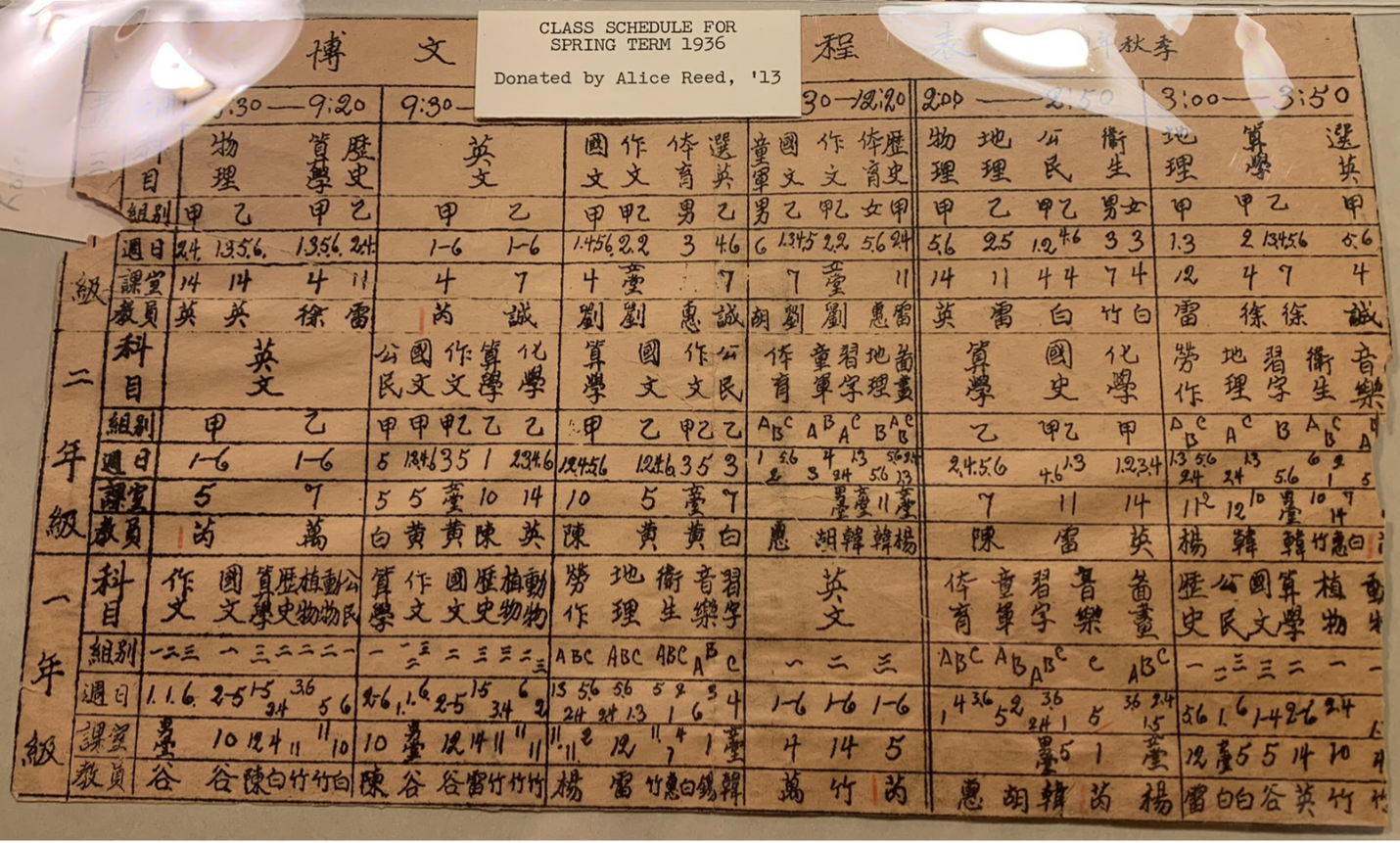
Figure 3. Class Schedule from the Porter-Wyckoff School, untranslated. “Class schedule for spring term, 1936,” schedule, 1936, in box 56, folder P30, GiC.
Needless to say, Porter and Wyckoff were explicitly Christian schools, and their education reflected this. They initially made both religious education (i.e., bible study) and attendance at Christian religious services mandatory for all students, but in 1925, religious education was made an elective in response to the threat of Nationalist (KMT)[92] school regulations on missionary schools. Specifically, the change was instituted in response to a motion passed by the National Education Association in 1924, which mandated that no compulsory religious education be given in any school. Previous motions passed by this association had been quickly adopted as government regulation, so the Grinnell-in-China missionaries chose to comply with it immediately.[93] Even after this change, however, the education offered through Grinnell-in-China remained substantially religious in character: While there was an initial drop in the number of students electing to take bible study from 178 to fifty (the entire student body had previously been taking it), the vast majority of students continued to voluntarily attend Christian religious services, with seventy-five percent of the student body attending Sunday services and seventy-two percent attending weekday ones.[94] This high attendance rate perhaps reflects the fact that a notable percentage of the student body were Chinese Christians, and that even those who weren’t seemed to appreciate the school’s religious character. In a short survey of a Porter Middle School class conducted in the 1920s,[95] four out of the eighteen boys (twenty-two per cent) said they had chosen Porter Middle because they were Christian, and fourteen out of eighteen (seventy-eight per cent) attributed their happiness at the school to it being a Christian institution.[96] Overall, the Grinnell-in-China missionaries seemed fairly sanguine about abandoning mandatory religious education, partially because they believed that voluntary evangelism would be more effective,[97] and partially because they saw traditional Chinese religion as self-evidently inferior. Protestant missionaries, including the Grinnell missionaries, created a dichotomy between Chinese religious practices and their own, contrasting their perceptions of Chinese religion as obscurantist, ritualistic, and materialist with Protestantism’s perceived rationality, simplicity, and spirituality.[98] In their Orientalist confidence, the Grinnell missionaries anticipated that their students would voluntarily opt for Christianity because, in their eyes, the superiority of Christianity over Chinese religious traditions was self-evident.
Complexity of Westernization
Grinnell-in-China was not solely about religious conversion, as one Grinnell student representative put it, ‘teaching a value system previously unknown to the Chinese’[99] one which ‘we American teachers imparted to them almost instinctively because it is so much a part of our culture.’[100] In other words, the missionaries sought to teach young Chinese to adopt Western culture and Western systems of value, or more specifically, American values.[101] That Grinnell-in-China aimed to Westernise its students had been clear from the start. This was expressed implicitly when the Scarlet and Black, Grinnell’s college newspaper, stated that Grinnell-in-China’s purpose was to rectify China’s greatest weakness: a ‘lack of men of character.’ This intention was stated much more explicitly when Alice Reed explained that Grinnell-in-China needed a kindergarten because ‘The Chinese seem to lack initiative, self-dependence, and bravery,’[102] adding that if ‘we could get these children at the kindergarten age, I feel there would be a good chance of offsetting some of these faults’[103] of traditional Chinese culture. The Westernization project was seen by the Grinnell-in-China missionaries as an honest effort to help their students in particular and all of China in general. After all, their goal was to train leaders who could strengthen China enough that it could resist the imperialism of the British and Japanese.[104] Edward Said defined Orientalism as a style of thought “for dominating, restructuring, and having authority over the Orient” in such a way that Western culture “gained in strength and identity by setting itself off against the Orient.”[105] Missionaries looked at Chinese culture and, seeing it through an Orientalist lens,[106] perceived it as the precise inverse of their own: Weak where they were strong, feminine where they were masculine, and submissive where they were dominant. This image of Chinese culture was widespread in contemporary missionary depictions of the country, and the Grinnell missionaries were clearly influenced by it.[107] Applying their judgment of Chinese civilization to their humanitarian goals, they reasoned that China’s inability to resist Western imperialism was rooted in its (perceived) cultural and spiritual inferiority, while the West’s ability to imperialize China was rooted in Western (perceived) superiority. Thus, if well-meaning Americans wanted to help the Chinese strengthen China, they had to start by making the Chinese more Western. Indeed, the entire operation ultimately stood on this premise, rendering relatively inoffensive aspects of their pedagogy (e.g., instilling the value of hard work) as elements of Western education, while disregarding the existence and appreciation of such virtues in China and elsewhere.
The missionaries attempted to introduce new customs into China as well as eliminate old ones through this Westernization project. The most basic and clearest manifestation of this intention was the banning of Chinese practices that the faculty found abhorrent, including foot-binding,[108] and any girl attending the Grace Wyckoff Memorial School had to unbind her feet.[109] However, the Grinnell-in-China missionaries extended this type of eliminationist approach towards other Chinese customs which were clearly harmless. For example, the Grinnell-in-China missionaries viewed the elite Chinese custom of letting the fingernails grow out as a sign of cultural sloth and lack of hyenine; this practice disappeared among Porter Middle School students under pressure from faculty. Besides, the implementation of a Western-style educational regime that included extensive chores and athletics made the maintenance of this custom basically impractical.[110] Competitive athletics, in particular, played an important role in Grinnell-in-China’s attempts to Westernise its students,[111] the faculty making contrasts between early 20th century Christian men with their muscular masculinity and Chinese men’s (perceived) weakness and femininity.[112] The Grinnell-in-China missionaries held deep-rooted assumptions of a connection between athletic skill and the ideals of diligence, individualism, and Christian morality, thereby deeming athletic training as inherently Western and good. And indeed, the introduction of competitive sports and athletics constituted one of the most successful and enduring elements of the missionaries’ program of Westernization, one which effectively replaced pre-existing literati norms that disdained open competition and physical exertion.[113] Their reports home devoted much space to descriptions of Porter’s athletic victories, celebrating the building of ‘a real worthwhile athletic spirit.’[114] Such satisfaction reflected a belief on the part of Grinnell-in-China that creating a new, Westernized Chinese citizenry was the most effective method to rescue China from the downfall caused by its own history and culture.
While the introduction of sports and the elimination of long fingernails might seem harmless changes, the implementation of Westernization was more broadly effective in teaching Porter-Wyckoff’s students to disdain their own culture. The missionaries criticized the Chinese lack of self-dependency and independent spirit, pointing to the practice that Chinese “children are taught to be afraid and are taken care of and waited on so that they have no chance to develop initiative.”[115] They passed this perception of Chinese passivity on to their students who, when asked what their education had done for them, noted that they “do not have the habits of luxury,” and “do not become weak.”[116] It must be noted that the context of these responses was an impromptu poll held by missionary teacher Harold Matthews. While this suggests that the students may have adjusted their answers to meet their teachers’ expectations, this in itself would in fact demonstrate how well students had internalized what was seen as good and progressive in their school curriculum. It is not hard to imagine that the reinforced practice of shunning things Chinese and praising things Western led to a sense of shame on the part of Chinese students, whose only salvation, as taught in their schools, lay in making themselves Westernized human beings.
Nevertheless, as with any Orientalist Westernization project, the Grinnell-in-China project was a multi-faceted, complex project, as can be seen in the schools efforts to promote Chinese leadership and simultaneous failure to secure Chinese-sourced financial assistance. From the beginning, the goal of the Grinnell-in-China project was to turn Chinese students into future leaders of China imbued with Christian and democratic values. As such, from the beginning, the missionaries saw their endeavor as a transient one: Once their goal had been achieved, they believed that the project would end.[117] In preparation for such an outcome, the missionaries worked to incorporate Chinese members into their leadership circle. Beginning in 1914, they not only allowed Chinese Christians to serve on the missions’ governance committees but mandated that half of each mission station’s representatives be Chinese.[118] Sinicization of the leadership extended to the faculty of Porter-Wyckoff, and by 1927, not only did native Chinese far outnumber missionary teachers at the schools,[119] Porter had also appointed a Chinese principal, Wang Yuan-hsin.[120] While this was done partially in response to the imminent implementation of Nationalist regulation,[121] it also reflected a real belief among the Grinnell-in-China missionaries that once the Chinese had been properly educated (and Westernized), they would be fully capable of educating, strengthening, and Westernizing China on their own. Indeed, to ensure their Chinese principal, Mr. Wang, received a proper American education, the Grinnell-in-China mission went to considerable trouble to ensure Mr. Wang spent the 1927-28 school year at the Grinnell College campus in Iowa.[122]
The missionaries’ confidence that their Chinese colleagues would support their project of Westernization may have been related to the fact that funding for the schools continued to depend on donations from the US, without which, the schools would have faced chronic deficits. Despite briefly turning a profit in the mid-1930’s,[123] Porter-Wyckoff suffered a more severe deficit in 1938 (the last year for which we have reliable records) than it had had in 1931 (the first year for which such records exist).[124] And while efforts were made to shift the financial burden onto the Chinese church,[125] there was never a period when the schools would have been able to operate without American donations.[126] Even in 1935, Porter-Wyckoff was ‘still receiving direct appropriations from the [American] Board.’[127] Whatever steps the missionaries took to give the Chinese an equal, or even dominant, role in running the mission institutions, the need to solicit funds from Americans back home meant that Western priorities, and Western (Orientalist) views of Chinese culture, were always going to dominate. Still, the effort on the part of the mission to include Chinese leaders and educators reflected the complex nuance of an Orientalist project in which local/native participation was solicited as part of the broader goal of culturally dominating the non-West via cultural imperialism.
Humanitarian Work
Grinnell-in-China was launched during a particularly turbulent period in Chinese history. Starting almost immediately after the founding of Grinnell-in-China in Dezhou, the region suffered from manifold disasters: flood (1917),[128] famine (1920),[129] plague (1921),[130] and war (1925).[131] In 1917, the Grand Canal burst its banks, flooding the Dezhou mission compound that contained the school and inflicting widespread damage throughout the area.[132] This disaster was almost immediately followed by a terrible famine as crops failed throughout Northern China.[133] Epidemics would periodically break out throughout the history of the schools, including a cholera epidemic in 1918[134] and a pneumonic plague outbreak in 1921.[135] Finally, war ravaged the region throughout this period as bandits, Communists, warlords, and KMT troops fought over control of Dezhou and the strategic manufacturing armory it contained.[136] The Grinnell-in-China missionaries did their best to help alleviate the suffering caused by these various crises, although their solutions were always filtered through an Orientalist understanding of China. Missionaries played a crucial, though contested, role in the provision of international aid in China. They served as both fundraisers, soliciting Western money to help alleviate Chinese suffering, and distributors, using their local knowledge to disburse those funds where they were most needed (a role that unfortunately created avenues for corruption, as well). While this work was significant, more recent scholarship has challenged the centrality of missionaries in our narratives, arguing that the omnipresence of missionaries and international aid in our source base is due to the comparative invisibility of traditional Chinese support networks, whose members were frequently illiterate. While this new scholarship does not reject missionaries’ important role in the solicitation and distribution of international aid, it does contextualise that role as a relatively minor one in the full narrative of Chinese relief efforts.[137]
Grinnell-in-China played an important role in distributing humanitarian aid to the residents of Shandong Province, particularly during the 1920 famine. Two relief programs that the mission offered stand out in particular: One in which laborers were hired to landscape the school grounds[138] and another involving the running of schools for poor girls and boys.[139] Both programs were intended to get money and food into the hands of starving Chinese. The missionaries created schools and a work program, rather than a simple soup kitchen. This was due to the assumption that the Chinese were slothful, and aid was thus provided in exchange for work with the intention of assisting Chinese to overcome their inherently passive and dependent tendencies and help them to build their own work ethic. It also included a felicitous (and intended) additional benefit, in that flood damage to the school grounds was repaired.[140] The schools for the poor provided food, clothing, and housing for the most vulnerable (and most likely to be abandoned) members of Chinese households, with the girls’ school at its peak caring for 140 girls[141] under the aegis of the Wyckoff school and Alice Reed,[142] and the boys’ school looking after 130 students,[143] Village-level famine schools fed as many as six thousand young boys. As educational institutions, these schools enabled the missionaries to expand their mission of spreading Western culture and values to the local population even as they saved lives. Beyond these two programs, Grinnell-in-China also served as a crucial conduit of international aid.
The North China famine of the 1920s saw one of the first serious efforts at providing international humanitarian aid, an effort Grinnell-in-China played a crucial part in. Not only did Grinnell missionaries write home to solicit humanitarian donations,[144] they also served as important organizers and distributors of international aid in Shandong Province. This was largely due to the strategic location of their mission compound in Dezhou, a city which served as the gateway to Shandong Province and through which a disproportionate amount of aid flowed: Over one million jin[145] of grain passed through Dezhou, sent by organizations such as the Red Cross, the London Missionary Society, and the British-American Tobacco Company.[146] The Grinnell-in-China missionaries, with their local knowledge and ability to interface with Western donors, proved crucial in distributing that aid, with Paul MacEachron, one of the Grinnell missionaries, running the commissary for all Red Cross work in the region.[147] The Local Relief Committee for the mission, operating outside of the Red Cross, estimated itself to have independently fed sixty thousand Chinese.[148] It should be clarified that missionary aid likely played a relatively small part in alleviating the damage caused by the famine,[149] with traditional Chinese support networks taking on the majority of the humanitarian burden. One example was a soup kitchen run by Chinese businessmen that, as Alice Reed noted, fed “about four thousand people daily.”[150] However, it is undeniable that within the realm of missionary aid, Grinnell played a crucial part, and that the humanitarian work of Grinnell-in-China missionaries did save lives and help the poor, despite its undertone of Orientalist bias toward Chinese people and their culture. The Grinnell-in-China missionaries would continue to provide emergency aid in times of crisis, such as during the 1929 famine[151] or during the repeated military conflicts that occurred in the region as the Chinese state disintegrated.[152] The missionaries also provided longer-running, more consistent forms of humanitarian aid. For example, the Dezhou mission station operated the Williams-Porter Hospital, which had been established in 1885.[153] This was the sole hospital serving two million people,[154] and treated around a thousand patients each year.[155]
In addition to medical and disaster aid, the mission’s welfare payments to poor Chinese Christians also deserve some attention: This system provided each family with fifty cents per family member per month, or just enough to avoid starvation.[156] The smallness of this amount reflected both the immensity of the need, which necessitated the broad provision of such aid, and the undercurrent of the assumption of the slothfulness and dependency of the Chinese on the part of the mission; it is undeniable, despite its life-saving measures, that this welfare program was founded upon a view of the Chinese poor as being naturally slothful, as previously seen in the work requirements tied to access to famine relief. The hospital, too, was used as a site of moral reform and evangelism. with patients being read The Lord’s Prayer.[157] After all, as the missionaries knew, “the first purpose of medical work is not to relieve the suffering of those who apply, … but to make it subservient to the larger purpose of awakening an interest in the Gospel message.”[158] A similar attitude accompanied much of the humanitarian work the Grinnell missionaries conducted in China. They saved lives, but their humanitarian efforts were always subordinate to their desire to Westernize and Christianize Chinese culture. While working toward these goals, they occasionally revealed their Orientalist biases toward the native population.
Conclusion
The Grinnell-in-China mission, though motivated by sincere humanitarianism, remained to the end a fundamentally Orientalist endeavour aimed at “civilizing” the Chinese. Launched at the height of American missionary fervor, from the outset, Grinnell-in-China viewed itself as a vehicle not only for the spread of Christianity to China, but also democracy and the values of hard work, independent thinking, and personal strength, which they saw as uniquely Western.[159] The Porter and Wyckoff schools were to train a new generation of Westernized Chinese Christians who could lead China into a bright, independent future, where the Chinese nation, thanks to those Western values, would be strong enough to stand up to foreign imperialism and take its place as an equal on the world stage.[160] These leaders were to be recruited from the population at as young an age as possible (to separate them from their parent culture)[161] and be immersed in an American-controlled boarding school environment that would mold their bodies and minds according to a American Christian model through an extensive program of academics, athletic events,[162] regimented chores, and lifestyles. This endeavour had the effect of discouraging and perhaps disparaging, whether explicitly or implicitly, Chinese customs and traditional practices, which the Grinnell-in-China missionaries saw as emblematic of the nation’s deficiencies and the cause of Chinese stagnation.[163]
The reader might wonder if the missionaries’ values even mattered in light of the good work they did: providing food to the starving,[164] medicine to the plague-stricken,[165] and knowledge to the uneducated.[166] Does it matter if the missionaries looked at China with an Orientalist gaze when their actions helped people in direct ways? Why should a project that saved thousands of Chinese lives be criticized? The missionaries meant well. Many of the changes they helped to drive – the discontinuation of foot-binding, the adoption of competitive sport, the clipping of men’s fingernails - do not, to us, seem particularly damaging. One must not forget, however, that the era in which the missionaries’ intentions were formed and their decisions made was one marked by a huge power imbalance between China and America. This gave these Americans the power to actively shape Chinese culture while denying the Chinese the agency to decide their own fate. One might also argue that the unidirectional imposition of Western cultural norms on Chinese youths robbed them of the conditions for self-determination and made them believe that their culture was inferior to that of the West. In the end, the missionaries, despite their good intentions, taught their students that their own culture was inferior, that it needed to be repaired, and that it should be replaced with that of America. The missionaries did good work, but this does not separate them from the harm they caused, nor does it place them above criticism for that harm. Still, this is a picture that warrants careful delineation of the material historical conditions at play, including Western advancement to China, Japanese aggression in Asia, changing internal political conditions in China in the period of transition from the premodern Imperial order to warlord-driven instability, natural disasters such as famine and plagues, all of this against the backdrop of an environment in which the vast Chinese masses lived in poverty and deprivation. Simply labelling Grinnell-in-China as an example of Orientalist evil will not lead to a productive discussion; nor will blindly praising its work as leading to the betterment of Chinese livelihoods result in comprehensive understanding. We must, as it were, tend to the nuances and imbalances that Orientalist projects create. As such, the Grinnell-in-China project was a complex enterprise, with many different aspects, both positive and negative, to consider. Nevertheless, ultimately, as Edward Said stressed, the role of global inequities of power in creating, maintaining, and distributing Orientalism cannot be denied: It was Western soldiers, traders, and missionaries who were able to go into the “Orient” in the first place, not the other way around.[167]
Peter Bramson graduated with honors from Grinnell College with a Bachelors of Arts in History and as a member of the Phi Beta Kappa society. He lives in Cary, North Carolina. His academic interests include international religious missions and the role of power in cross-cultural interactions.
Bibliography
Alex Mayfield, Daryl Ireland, and Eugenio Menegon. China Historical Christian Database. V1. Center for Global Christianity and Mission, Boston University, June 24, 2022. Accessed May 10, 2023. https://data.chcdatabase.com.
American Board of Commissioners for Foreign Missions. American Board of Commissioners for Foreign Missions archives, 1810-1974. Houghton Library, Harvard University.
American Board of Commissioners for Foreign Missions. American Board of Commissioners for Foreign Missions, China. Records, 1816-1967. Harvard Divinity School Library, Harvard University.
Birsh, Arthur, and Ronald Vance. “A History of Yale-in-China.” Unpublished Manuscript. April 1952. Yale China Association. Manuscripts and Archives, Yale University.
Bowers, Lisa M. “A History of Grinnell-in-China 1910-1930.” Unpublished Manuscript. May 10, 1980. Grinnell-in-China Papers. Burling Library, Grinnell College.
Chow, Tse-tsung. “VII. Expansion of the New Culture Movement, 1919-1920,” in Chow, Tse-tsung, The May Fourth Movement: Intellectual Revolution in Modern China, 171-196. Cambridge, MA: Harvard University Press, 1960.
Christensen, Erleen J. In War and Famine: Missionaries in China’s Honan Province in the 1940s. Montréal: McGill-Queen’s University Press, 2005.
Cohen, Warren I. America’s Response to China: A History of Sino-American Relations. 5th edition. New York: Columbia University Press, 2010.
Corbett, Charles Hodge. Shantung Christian University (Cheeloo). United Board for Christian Colleges in China, 1955.
Decker, William M. The Foundations and Growth of Shantung Christian University, 1864-1917. Doctoral dissertation, Columbia University, New York, 1948.
Fairbank, John K. ed., The Missionary Enterprise in China and America. Cambridge, MA: Harvard University Press, 2014.
Field, James A. “Near East Notes and Far East Queries” in John K. Fairbank ed., The Missionary Enterprise in China and America. Cambridge, MA: Harvard University Press, 2014.
Fuller, Pierre E. Struggling with Famine in Warlord China: Social Networks, Achievements, and Limitations, 1920-21. Doctoral dissertation, University of California, Irvine, 2011.
Graham, Gael. “Exercising Control: Sports and Physical Education in American Protestant Mission Schools in China, 1880-1930,” Signs: Journal of Women in Culture and Society Vol. 20, No. 1 (October 1994), pp. 23–48.
Graham, Gael Norma. Gender, Culture, and Christianity: American Protestant Mission Schools in China, 1880-1930. Doctoral dissertation, University of Michigan, 1990.
Grinnell-in-China Papers. Burling Library Special Collections. Grinnell College.
Hong, Fang. Footbinding, Feminism, and Freedom: The Liberation of Women’s Bodies in Modern China. London: Frank Cass, 1997.
Hunter, Jane. The Gospel of Gentility: American Women Missionaries in Turn-of-the-Century China. New Haven: Yale University Press, 1989.
Johnson, H. T. “Postwar Optimism and the Rural Financial Crisis of the 1920's,” Explorations in Economic History Vol. 11, No. 2 (Winter, 1973): 173.
Ko, Dorothy. Cinderella's Sisters: A Revisionist History of Footbinding. Berkeley, CA: University of California Press, 2005.
Lear, Shana D. Examining Protestant Missionary Education in North China: Three Schools for Girls, 1872-1924. Columbus, OH: The Ohio State University, 2009.
Lodwick, Kathleen L. Educating the Women of Hainan: The Career of Margaret Moninger in China, 1915-1942. Lexington, KY: University Press of Kentucky, 1995.
Lodwick, Kathleen L. How Christianity Came to China: A Brief History. Paris: National Book Network, 2016.
Matthews, Harold S. Seventy-Five Years of the North China Mission. Peking: Yenching University, 1936.
Matthews, Harold S. Some Historical Notes Pertaining to the Experiences of the North China American Board Mission 1935-1960 This Being the Fourth Quarter of the One-Hundred Years of Its History. Boston, MA: American Board, 1967.
Miller, Stuart C. “Ends and Means: Missionary Justification of Force in Nineteenth Century China,” in in John K. Fairbank ed., The Missionary Enterprise in China and America. Cambridge, MA: Harvard University Press, 2014.
Petras, James (1999). “NGOs: In the service of imperialism,” Journal of Contemporary Asia Vol. 29, No. 4, pp. 429-440.
Phillips, Clifton. “The Student Volunteer Movement and Its Role in China,” in John K. Fairbank ed., The Missionary Enterprise in China and America. Cambridge, MA: Harvard University Press, 2014.
Putnery, Clifford. Muscular Christianity: Manhood and Sports in Protestant America, 1880-1920. Cambridge, MA: Harvard University Press, 2001.
Reed, Alice C. Excerpts from letters from China written by Alice Reed to Her family and Friends during the years 1916-1948. Self-Published Letters, Claremont, California, 1966. Grinnell-in-China Papers. Burling Library, Grinnell College.
Reed, James. The Missionary Mind and American East Asia Policy, 1911-1915. Cambridge: Harvard University Press, 1983.
Reinders, Eric Robert. Borrowed Gods and Foreign Bodies: Christian Missionaries Imagine Chinese Religion. Berkeley, CA: University of California Press, 2004.
Said, Edward W. Orientalism. New York: Vintage, 1979.
Schlesinger Jr., Arthur. “The Missionary Enterprise and Theories of Imperialism,” in John K. Fairbank ed., The Missionary Enterprise in China and America. Cambridge, MA: Harvard University Press, 2014.
Swanson, Herb. “Said’s Orientalism and the Study of Christian Missions,” International Bulletin of Mission Research Vol. 28, Issue 3, pp. 107-112.
Tomlinson, John. Cultural Imperialism: A Critical Introduction. London: Continuum, 1991.
Wall, Joseph Frazier. Grinnell College in the nineteenth century: from salvation to service. United States: Iowa State University Press, 1997.
Wilbur, C. Martin. The Nationalist Revolution in China 1923-1928. Cambridge: Cambridge University Press, 1983.
Yu, Lan. Orientalism and Missionary Sinology, A Study of W.A.P. Martin. Master’s thesis, University of New Brunswick, 1997.
Zhang, Huijie, Fan Hong, and Fuhua Huang. “Cultural Imperialism, Nationalism, and the Modernization of Physical Education and Sport in China, 1840–1949,” The International Journal of the History of Sport Vol. 35, No. 1 (January 2, 2018), pp. 43–60.
[1] Lisa M. Bowers, “A History of Grinnell-in-China 1910-1930” (Unpublished Manuscript, May 10, 1980), 4-5, Box 56, Folder P27, Grinnell-in-China Papers, Burling Library, Grinnell (Hereafter GiC).
[2] The American Board of Commissioners for Foreign Missionaries was an interdenominational organization to organize and support Protestant missionaries founded in 1810. See James A. Field, “Near East Notes and Far East Queries” in John K. Fairbank ed., The Missionary Enterprise in China and America (Cambridge, MA: Harvard University Press, 2014), 29.
[3] Harold S. Matthews, Seventy-Five Years of the North China Mission (Peking: Yenching University, 1936), 104.
[4] These were originally two separate schools, Porter Middle School for Boys and the Grace Wyckoff Memorial School for Girls, but they were merged into a single, co-ed, institution in 1929. See Bowers, “A History of Grinnell-In-China,” 44, in box 56, folder P27, GiC.
[5] I have chosen to use the modern form of romanization in this paper. Several of my archival sources use the older romanization of Techow.
[6] This university was run by the Presbyterian Shantung Mission. See Bowers, “A History of Grinnell-in-China 1910-1930,” 5, in box 56, folder P27, GiC. Also, Alex Mayfield, Daryl Ireland, and Eugenio Menegon, China Historical Christian Database, V1, June 24, 2022, accessed May 10, 2023, https://data.chcdatabase.com.
[7] Bowers, “A History of Grinnell-in-China 1910-1930,” 6.
[8] Arthur Schlesinger Jr., “The Missionary Enterprise and Theories of Imperialism” in John K. Fairbank ed., The Missionary Enterprise in China and America (Cambridge, MA: Harvard University Press, 2014).
[9] Cultural imperialism is defined in “The Missionary Enterprise and Theories of Imperialism” by Arthur Schlesinger Jr. as the attack on the ideas and values of one culture by another. See Arthur Schlesinger Jr., “The Missionary Enterprise and Theories of Imperialism,” 363.
[10] The American Board of Commissioners for Foreign Missionaries was an interdenominational organization to organize and support Protestant missionaries founded in 1810. It dominated American missionary efforts and remained influential until Mao closed China. See James A. Field, “Near East Notes and Far East Queries” in John K. Fairbank ed., The Missionary Enterprise in China and America (Cambridge, MA: Harvard University Press, 2014), 29.
[11] Harold S. Matthews, Seventy-five Years of the North China Mission (Peking: Yenching University, 1936), 104.
[12] Bowers, “A History of Grinnell-in-China 1910-1930,” 4-5, Box 56, Folder P27, GiC.
[13] These were originally two separate schools, Porter Middle School for Boys and the Grace Wyckoff Memorial School for Girls but were merged into a single, co-ed, institution in 1929. Bowers, “A History of Grinnell-in-China,” 44, in box 56, folder P27, GiC.
[14] I have chosen to use the modern romanization in this paper. Several of my archival sources use the older romanization of Techow.
[15] This university was run by the Presbyterian Shantung Mission. See Bowers, “A History of Grinnell-in-China 1910-1930,” 5, in box 56, folder P27, GiC. See also Alex Mayfield, Daryl Ireland, and Eugenio Menegon, China Historical Christian Database, V1, 24 June 2022, accessed 10 May 2023, https://data.chcdatabase.com.
[16] Bowers, “A history of Grinnell-in-China 1910-1930,” 6, GiC.
[17] See Arthur Schlesinger Jr., “The missionary enterprise and theories of imperialism.”
[18] Here, Orientalism is used in Edward Said’s sense of a matrix of ideas and knowledge created by Western hegemony about the (slippery) geographic region of ‘the Orient’ that serves more as an Other to define the Occident against than as an accurate depiction of ‘Oriental’ cultures and countries. See Edward W. Said, Orientalism (New York: Vintage, 1979).
[19] Cultural imperialism is defined in “The missionary enterprise and theories of imperialism” by Arthur Schlesinger Jr. as the attack on the ideas and values of one culture by another. See Arthur Schlesinger Jr., “The missionary enterprise and theories of imperialism,” 363. For a general look at the concept of cultural imperialism and how it is used in the academy more broadly, see John Tomlinson, Cultural Imperialism: A Critical Introduction (London: Continuum, 1991). Tomlinson, John, Cultural Imperialism: A Critical Introduction (London: Continuum, 1991).
[20] Matthews, Harold S, Seventy-five Years of the North China Mission (Peking: Yenching University, 1936).
[21] Graham, Gael, “Exercising control: sports and physical education in American Protestant mission schools in China, 1880-1930,” Signs: journal of women in culture and society 20, no. 1 (October 1994): 23–48. https://doi.org/10.1086/494953 and Graham, Gael Norma, Gender, Culture, and Christianity: American Protestant mission schools in China, 1880-1930, Doctoral dissertation, University of Michigan, 1990.
[22] Lodwick, Kathleen L, Educating the Women of Hainan: The Career of Margaret Moninger in China, 1915-1942, (Lexington, KY: University Press of Kentucky, 1995).
[23] Lan Yu, Orientalism and Missionary Sinology, A Study of W.A.P. Martin, Master’s Thesis, University of New Brunswick, 1997, 158-161.
[24] Eric Robert Reinders, Borrowed Gods and Foreign Bodies: Christian Missionaries Imagine Chinese Religion (Berkeley, CA: University of California Press, 2004), 218.
[25] Herb Swanson, “Said’s Orientalism and the Study of Christian Missions. - Free Online Library,” accessed August 31, 2024, https://www.thefreelibrary.com/Said%27s+Orientalism+and+the+study+of+Christian+missions. -a0119613629.
[26] James A. Field, “Near East Notes and Far East Queries,” 29.
[27] Field, “Near East Notes and Far East Queries,” 31.
[28] Field, “Near East Notes and Far East Queries,” 55.
[29] These treaties, negotiated at gunpoint after the Opium Wars, guaranteed missionaries the right to travel and own property in China’s interior, which had previously been sealed off from outsiders. They also granted missionaries extraterritoriality. Missionaries played a crucial role in drafting the treaties as translators. See Kathleen L. Lodwick, How Christianity Came to China: A Brief History (Paris: National Book Network, 2016), 14-16. See also Stuart C. Miller, “Ends and Means: Missionary Justification of Force in Nineteenth Century China” in John K. Fairbank ed., The Missionary Enterprise in China and America (Cambridge, MA: Harvard University Press, 2014), 249 and 262.
[30] Matthews, Seventy-five Years of the North China Mission, 3.
[31] Romanized as Tientsin in Matthews, Seventy-five Years of the North China Mission, 6.
[32] Matthews, Seventy-five Years of the North China Mission, 6.
[33] Or rather what would become it. The mission station was originally located in a rural village some distance from the city of Dezhou, and would not be relocated to a more central location until 1911. Matthews, Seventy-five years of the North China Mission, 104.
[34] I was not able to determine the modern romanization of the name of this village, so the name is presented as it appears in my sources.
[35] Matthews, Seventy-five Years of the North China Mission, 26.
[36] Matthews, Seventy-five Years of the North China Mission, 27.
[37] Expanding to nine stations with the incorporation of the Shaanxi mission in 1914. See Matthews, Seventy-five Years of the North China Mission, 32.
[38] Matthews, Seventy-five Years of the North China Mission, 38.
[39] For our purposes, Shantung Christian University, as the only missionary university in Shandong, is most relevant, but Yenching University was the original apex of this system. See Matthews, Seventy-five Years of the North China Mission, 98-100. Also, American Board of Commissioners for Foreign Missions (ABCFM), “Occasional notes from Shantung Christian University,” 10 June 1922, Collection Identifier bms 1003, Box 17, Folder 9, China, Records, c. 1816-1967, Harvard Divinity Library, Harvard University (Hereafter Divinity Papers).
[40] Technically speaking Oberlin was the progenitor of the Shaanxi mission, which would not be folded into the North China mission until 1914. See Matthews, Seventy-five Years of the North China Mission, 32 and 49.
[41] Bowers, “A History of Grinnell-in-China 1910-1930,” 4-5, in box 56, folder P27, GiC.
[42] Bowers, “A History of Grinnell-in-China 1910-1930,” 4-5, in box 56, folder P27, GiC.
[43] Their prominence was due to both the greater religiosity of this region and the tendency of the SVM to schedule major recruitment events in the Midwest. See Clifton Philips, “The Student Volunteer Movement and Its Role in the China Missions, 1886-1920,” in The Missionary Enterprise in China and America, ed. John K. Fairbank (Cambridge, MA: Harvard University Press, 2014), 98.
[44] The northeast was another region notable for its missionary activity, and indeed this was where the missionary fervor began, but the centre of the American missionary movement quickly moved west. See Philips, “The Student Volunteer Movement and Its role in the China Missions, 1886-1920,” 98.
[45] Yali, as the Yale-in-China mission was known, began in 1903, and the example of Yale was repeatedly invoked in order to drum up support for Grinnell-in-China. See Arthur Birsh and Ronald Vance, ‘A history of Yale-in-China’ (Unpublished Manuscript, April 1952), 6-7, Yale China Association, Series 13, Manuscripts and Archives, Yale University. Also, Bowers, “A history of Grinnell-in-China 1910-1930,” 15, in box 56, folder P27, GiC.
[46] Matthews, Seventy-five Years of the North China Mission, 49.
[47] Bowers, “A History of Grinnell-in-China 1910-1930,” 4-5, in box 56, folder P27, GiC.
[48] In practice, Grinnell College always provided the lion's share of GiC’s funding and thus had by far the greater influence on the administration of the program. See Bowers, “A History of Grinnell-in-China 1910-1930,” 4-5 and 15, in box 56, folder P27, GiC.
[49] This spirit could be summarised as the idea that Grinnellians as a group and Grinnell as an institution were uniquely committed in their lives and careers to working to fulfil great social needs wherever they happened to find them. Thought to be a continuation of the spirit in which the college itself was founded, with members of the ‘Iowa Band’ leaving their comfortable East Coast homes and travelling to Iowa in order to fulfil its social need for education and the gospel. The Grinnell Spirit was the encapsulation of the unique culture and values that Grinnell believed itself to possess. See Bowers, “A History of Grinnell-in-China 1910-1930,” 14-15, GiC.
[50] For more information on the founding of Grinnell College, see Joseph Frazier Wall, Grinnell College in the Nineteenth Century: From Salvation to Service, Ames, IA: Iowa State University Press, 1997.
[51] China Committee of Grinnell-in-China, “Tell me about Grinnell-in-China,” booklet, 1935, 2, in box 56, folder P8, Grinnell-in-China Papers, Burling Library Special Collections, GiC.
[52] “Given Commission for work in China,” Scarlet and Black, newspaper, 30 May 1916, in box 56, folder P3, 2, GiC.
[53] Bowers, “A History of Grinnell-in-China 1910-1930,” 15, in box 56, folder P27, GiC.
[54] Bowers, “A History of Grinnell-in-China 1910-1930,” 16, GiC.
[55] “China’s need told by Edward Munson, a former student,” Scarlet and Black, newspaper, 5 May 1916, in box 56, folder P3, 3, GiC.
[56] “China’s need told by Edward Munson, a former student,” 3, GiC.
[57] “China’s need told by Edward Munson, a former student,” 3, GiC.
[58] “The eleventh annual report of the Williams Hospital at Pang Chuang, Shantung, For 1890,” 1891, Collection Identifier bms 1003, Box 17, Folder 2, Divinity Papers.
[59] This was the idea that “the world was turning - or ought to turn - towards Christianity and democracy” (James Reed, The Missionary Mind, 8).
[60] Bowers, “A History of Grinnell-in-China 1910-1930,”14, in box 56, folder P27, GiC.
[61] Bowers, “A History of Grinnell-in-China 1910-1930,” 6, in box 56, folder P27, GiC.
[62] Bowers, “A History of Grinnell-in-China 1910-1930,” 6 in box 56, folder P27, GiC.
[63] Matthews, Seventy-five Years of the North China Mission, 134.
[64] Matthews, Seventy-five Years of the North China Mission, 134.
[65] Alice C. Reed, Excerpts from Letters from China Written by Alice Reed to Her Family and Friends during the Years 1916-1948 (Self-Published Letters, Claremont, California, 1966), x, GiC.
[66] “Williams and Porter Hospitals and training school for nurses,” page 1, 1920, Collection Identifier bms 1003, Box 17, Folder 20, Divinity Papers.
[67] “Four minute summary for 1929,”, 9 May 1930, Collection Identifier bms 1003, Box 17, Folder 20, Divinity Papers; “Report of the Techow Famine Relief Committee” in North China Mission: 1920-1929, vol. 3, p. 135, 1921, ABC 16.3.12, Volume 39, American Board of Commissioners for Foreign Missions Archives, 1810-1961, Houghton Library, Harvard University (Hereafter Houghton Papers).
[68] Bowers, “A History of Grinnell-in-China 1910-1930,” 29 in box 56, folder P27, GiC. See also Fuller, Struggling with Famine in Warlord China, 313-314.
[69] Donal R. Fessler, “Grinnell-in-China’s role in the educational life of China,” memoir manuscript, 7, in box 56, in folder P28, GiC.
[70] Porter-Wyckoff was “the only junior and senior high school [for students aged 11-18] in thirty-two counties with a population of more than five million,” Report, 0001p2, in box 56, folder p22, GiC.
[71] See the deficit of -1,274 (currency unclear from records, assumed to be in dollars) as late as 1939. “Middle schools under the council [1939]” in A.B.C.F.M North China 1930-1939: statistics, 1931-1939, letters, 1930, 1931-A-L, vol. 8, 1939, ABC 16.3.12, Volume 57, Houghton Papers.
[72] Reed, Excerpts from Letters from China, 227.
[73] Bowers, “A History of Grinnell-in-China,” 44, GiC.
[74] Report, 0001p2, in box 56, folder p22, GiC.
[75] Report, 0001p2, in box 56, folder p22, GiC.
[76] Bowers, “A History of Grinnell-in-China,” 44, GiC.
[77] Harold S. Matthews, “Porter Middle School,” letter, 2, in box 56, folder P10, GiC.
[78] Dating of the Matthews letter was determined by cross-referencing a letter by Wehrman in which he encloses it, noting that “letters dated there as late as December 27th state that their work is undisturbed by the upheaval.” See Harold S. Matthews, “Porter Middle School,” letter, 2, in box 56, folder P10, GiC and Nelson W. Wehrman, letter, in box 56, folder P12, GiC.
[79] “Porter Middle School, 1923. The principal’s report” in A.B.C.F.M North China 1930-1939: Statistics, 1931-1939, Letters, 1930, 1931-A-L, vol. 8, 1939, ABC 16.3.12, Volume 57, Houghton Papers.
[80] Bowers, “A History of Grinnell-in-China,” 36, GiC.
[81] The student body would reach 369 students in 1925 before falling to as low as 143 in 1931. “Tehsien Station - general report for 1925” in North China Mission: 1920-1929, vol. 3, p. 140, 1921, ABC 16.3.12, Volume 39, Houghton Papers. See also “Provincial Middle Schools, 1931” in A.B.C.F.M North China 1930-1939: Statistics, 1931-1939, letters, 1930, 1931-A-L, vol. 8, 1939, ABC 16.3.12, Volume 57, Houghton Papers and “The Grinnell-in-China educational movement,” pamphlet, 2, in box 56, folder P5, GiC. China Committee, “Tell me about Grinnell-in-China,” booklet, 1, in box 56, folder P8, GiC.
[82] Matthews, “Porter Middle School,” 1, GiC.
[83] I have chosen not to focus on the role of Shantung Christian University (or Cheelo, as it was called) as existing scholarship on the subject can be found in Charles Hodge Corbett, Shantung Christian University (Cheeloo) (United Board for Christian Colleges in China, 1955) and William M. Decker, The Foundations and Growth of Shantung Christian University, 1864-1917, Doctoral dissertation, Columbia University, New York, 1948.
[84] This last class was likely required by the Nationalist government for accreditation. See “Class schedule for spring term, 1936,” schedule, 1936, trans. Professor Jomo Smith, in box 56, folder P30, GiC.
[85] The Wyckoff school did not offer any education at this grade level until the two schools were combined in 1929. See Bowers, “A history of Grinnell-in-China,” 44, GiC.
[86] Matthews, “Porter Middle School,” 1, GiC and Bowers, “A history of Grinnell-in-China,” 38, GiC.
[87] Matthews, “Porter Middle School,” 2, GiC.
[88] An example of this is the participation of the Porter Middle School boys in the 1925 student strikes against the unequal treaties that were sparked by the shooting of unarmed protesters on British orders in Shanghai. The students disrupted classes for several days but my sources do not record specific demands on their part beyond a desire to demonstrate solidarity with striking students elsewhere (these strikes extended across all of China). See “School notes for the second semester - February to June 1925,” notes, 0003p5, in box 56, in folder P22, GiC. The author is likely to be Harold Matthews, but no name is attached to the document.
[89] Unfortunately, my source fails to provide any specific details on the form this social service took or how long it persisted. See Matthews, “Porter Middle School,” 2, GiC.
[90] “Daily vacation bible schools, 1923” in North China Mission: 1920-1929, vol. 3, p. 140, 1921, ABC 16.3.12, Volume 39, Houghton Papers.
[91] “School notes for the second semester- February to June 1925,” 2, GiC.
[92] Details about the Nationalist government and the KMT in this period can be found in C. Martin Wilbur, The Nationalist revolution in China 1923-1928 (Cambridge: Cambridge University Press, 1983).
[93] “Reporting on the actions of the National Educational ASS’n. October 1924,” annex to the annual report, in box 56, in folder P22-4, in GiC. See also “Minutes of annual meeting of the Grinnell-in-China Field Committee, 2 February 1925, in Peking,” minutes, 0007p1, in box 56, folder P22, GiC.
[94] Alfred D. Heininger and Harold S. Matthews, untitled pamphlet, 0024p2-3, in box 56, in folder P22, GiC.
[95] The document relating the survey itself is undated, but the survey was conducted by Harold Matthews, who worked in China from 1923-1930. Based on the documents this survey was stored with, I would estimate it is from 1924-1925.
[96] Harold S. Matthews, “Testimony that tells,” pamphlet, 00023p1-2, in box 56, in folder P22, GiC.
[97] Matthews, “Porter Middle School,” 2, GiC.
[98] Reinders, Borrowed Gods and Foreign Bodies, 63-65 and 212.
[99] Donal R. Fessler, “Grinnell-in-China’s role in the educational life of China,” memoir manuscript, 7, in box 56, in folder P28, GiC.
[100] Fessler, “Grinnell-in-China’s role in the educational life of China,” 9, GiC.
[101] For more details about the ways in which Protestant missionary schools in China attempted to ‘civilise’ their students, see Gael Norma Graham, Gender, Culture, and Christianity: American Protestant Mission Schools in China, 1880-1930, Doctoral dissertation, University of Michigan, 1990.
[102] Ms. Reed at least refuses to attribute these faults ‘to any racial characteristics’: Reed, Excerpts from letters from China, 17-18. In her mind, these are purely defects of Chinese culture and can thus be remedied with appropriate education. Reed, Excerpts from letters from China, 17-18, GiC.
[103] Reed, Excerpts from Letters from China, 18, GiC.
[104] Bowers, “A History of Grinnell-in-China 1910-1930,” 6, GiC.
[105] Edward W. Said, “Introduction,” Orientalism (New York: Vintage, 1979), 3.
[106] Edward W. Said, Orientalism (New York: Vintage, 1979).
[107] Reinders, Borrowed Gods and Foreign Bodies, 209-210.
[108] The then widespread practice of binding a young girls’ feet when they were young so that their growth would be restricted. This was traditional in Chinese culture and was at least partially driven by women’s desire to ‘marry-up,’ as small feet were seen as a sign of elite status and beauty. For a more detailed look at the history of this practice and the role of missionaries in ending it, see Fang Hong, Footbinding, Feminism, and Freedom (London: Frank Cass, 1997) and Dorothy Ko, “Introduction” in Cinderella's Sisters: A Revisionist History of Footbinding (Berkeley, CA: University of California Press, 2005).
[109] Untitled, letter, 0001p8, in folder 56, in box P22, GiC.
[110] Fessler, “Grinnell-in-China’s role in the educational life of China,” 7, GiC.
[111] Bowers, “A history of Grinnell-in-China 1910-1930,” 32, GiC.
[112] For further reading on muscular Christianity, see Clifford Putney, Muscular Christianity: Manhood and Sports in Protestant America, 1880-1920 (Cambridge, MA: Harvard University Press, 2001). To learn more about how this contrasted with contemporary perceptions of China, see Eric Reinders, Borrowed Gods and Foreign Bodies (Berkeley, CA: University of California Press, 2004).
[113] See Huijie Zhang, Fan Hong, and Fuhua Huang, “Cultural Imperialism, nationalism, and the modernization of physical education and sport in China, 1840–1949,” The international Journal of the History of Sport Vol. 35, No. 1 (2 January 2018): 43–60. https://doi.org/10.1080/09523367.2018.1500460. See also Gael Graham, “Exercising control: sports and physical education in American Protestant mission schools in China, 1880-1930,” Signs: journal of women in culture and society Vol. 20, No. 1 (October 1994): 23–48. https://doi.org/10.1086/494953.
[114] “School notes for the second semester- February to June 1925,” 2, GiC.
[115] Reed, Excerpts from letters from China, 18.
[116] See Alfred D. Heininger and Harold S. Matthews, untitled pamphlet, 0024p3, in box 56, in folder P22, GiC.
[117] “Tehsien Station general report for the year 1922” in North China Mission: 1920-1929, vol. 3, p. 140, 1921, ABC 16.3.12, Volume 39, Houghton Papers.
[118] Matthews, Seventy-five Years of the North China Mission, 124-125.
[119] Ratio of fourteen Chinese to one American determined by counting Western and Chinese names. See ‘Annual report, February 1927-February 1928,’ 1928, Collection Identifier bms 1003, Box 17, Folder 21, Divinity Papers.
[120] Principal Wang’s service as principal was frequently interrupted by the various crises that overtook Grinnell-in-China as the century progressed. For example, Alice Reed held the position in 1938, when he had to flee the Japanese occupation, but he seems to have been seen as the default, or ‘rightful’ principal from his hiring onward. See, Bowers, “A history of Grinnell-In-China 1910-1930,” 45, GiC and Reed, Excerpts from letters from China, 124, GiC.
[121] “Reporting on the actions of the National Educational ASS’n. October 1924,” annex to the annual report, in box 56, in folder P22-4, in GiC. See also “Minutes of annual meeting of the Grinnell-in-China Field Committee, 2 February 1925, in Peking,” minutes, 0007p1, in box 56, folder P22, GiC.
[122] As Grinnell College was under considerable financial strain during this period, facilitation of Mr. Wang’s travel across the Pacific and funding of his studies abroad required an enormous effort on the part of the mission and the college. See Nelson W. Wehrhan, letter, 1926, 1, in box 56, folder P12, in GiC, and Nelson W. Wehrhan, letter, 1926, 1, in box 56, folder P22-4, in GiC.
[123] “Middle schools under the council [1935]” in A.B.C.F.M North China 1930-1939: statistics, 1931-1939, letters, 1930, 1931-A-L, vol. 8, 1939, ABC 16.3.12, Volume 57, Houghton Papers.
[124] “Provincial middle schools, 1931” in A.B.C.F.M North China 1930-1939: statistics, 1931-1939, letters, 1930, 1931-A-L, vol. 8, 1939, ABC 16.3.12, Volume 57, Houghton Papers; “Middle schools under the council [1938]” in A.B.C.F.M North China 1930-1939: statistics, 1931-1939, letters, 1930, 1931-A-L, vol. 8, 1939, ABC 16.3.12, Volume 57, Houghton Papers.
[125] “Tehsien Station general report for the year 1922” in North China Mission: 1920-1929, vol. 3, p. 140, 1921, ABC 16.3.12, Volume 39, Houghton Papers.
[126] See the 1935 booklet created to secure further funding from Grinnell, made in one of the few years in which Porter-Wyckoff took in more in tuition than it paid out in expenses. Even when the schools were in the black, the mission station could not imagine getting by without American money. China Committee, “Tell me about Grinnell-in-China,” booklet, in box 56, folder P8, GiC.
[127] Matthews, Harold S, Some Historical Notes Pertaining to the Experiences of the North China American Board Mission 1935-1960 This Being the Fourth Quarter of the One-hundred Years of Its History (Boston, MA: American Board, 1967), 18.
[128] Bowers, “A history of Grinnell-in-China 1910-1930,” 27, GiC.
[129] Reed, Excerpts from Letters from China, 55, GiC.
[130] Reed, Excerpts from Letters from China, 63, GiC.
[131] Dated from the outbreak of fighting in Dezhou between two local warlords. See Reed, Excerpts from Letters from China, 82-83, GiC.
[132] Bowers, “A history of Grinnell-in-China 1910-1930,” 27, GiC and Reed, Excerpts from Letters from China, 26.
[133] Reed, Excerpts from Letters from China, 55, GiC.
[134] Bowers, “A history of Grinnell-In-China 1910-1930,” 27, GiC and Reed, Excerpts from Letters from China, 27.
[135] Reed, Excerpts from Letters from China, 63, GiC.
[136] “Grinnell and China field of work,”' Scarlet and Black, newspaper, 1916, in box 56, folder P3, 1, GiC.
[137] Erleen J. Christensen, In War and Famine: Missionaries in China’s Honan Province in the 1940’s (Montréal: McGill-Queen’s University Press, 2005), 104-105 and 118-119. See also Pierre E. Fuller, Struggling with Famine in Warlord China: Social Networks, Achievements, and Limitations, 1920-21 (Doctoral dissertation, University of California, Irvine, 2011), x-xi.
[138] Bowers, “A history of Grinnell-in-China 1910-1930,” 29, GiC.
[139] Untitled report in North China Mission: 1920-1929, vol. 3, p. 134, 1921, ABC 16.3.12, Volume 39, Houghton Papers.
[140] Bowers, “A history of Grinnell-in-China 1910-1930,” 29, GiC.
[141] Untitled report in North China Mission: 1920-1929, vol. 3, p. 134, 1921, ABC 16.3.12, Volume 39, Houghton Papers.
[142] Reed, Excerpts from Letters from China, 61-62, GiC.
[143] Untitled report in North China Mission: 1920-1929, vol. 3, p. 134, 1921, ABC 16.3.12, Volume 39, Houghton Papers.
[144] Paul MacEachron, “Famine conditions in Northern China appalling - parents kill children when food gives out,” Scarlet and Black, newspaper, 1920, 1, in box 56, in folder P17, in GiC.
[145] One jin is approximately 600 grams. See Fuller, Struggling with famine in warlord China, 26.
[146] Fuller, Struggling with Famine in Warlord China, 413.
[147] This work was focused on hiring Chinese men to work on road-building projects, following similar logic to Grinnell-in-China’s decision to hire them to repair the mission station grounds. See Reed, Excerpts from Letters from China, 62, GiC.
[148] Untitled report in North China Mission: 1920-1929, vol. 3, p. 134, 1921, ABC 16.3.12, Volume 39, Houghton Papers.
[149] Fuller, Struggling with famine in warlord China, x-xi.
[150] Reed, Excerpts from Letters from China, 63, GiC.
[151] “Four minute summary for 1929,” 1929, Collection Identifier bms 1003, Box 17, Folder 2, Divinity Papers.
[152] “War notes from Techow” in North China Mission: 1920-1929, vol. 3, p. 144, 1926, ABC 16.3.12, Volume 39, Houghton Papers.
[153] Matthews, Seventy-five Years of the North China Mission, 28.
[154] “Seven facts,” 1925?, Collection Identifier bms 1003, Box 17, Folder 20, Divinity Papers.
[155] For example: 934 in-patients in 1919, 1,100 in 1928, and 1,069 in 1938. Note that the number of in-patients only accounts in part for extent of the hospital’s work as it typically included out-patients and those using prescription services as well. See “Annual summary for 1919,” 1920, Collection Identifier bms 1003, Box 17, Folder 20, Divinity Papers. Also, “Williams - Porter Hospital Techow, Shantung, China, two minutes,” 1928, Collection Identifier bms 1003, Box 17, Folder 20, Divinity Papers; “Williams Porter Hospital, Techow, Shantung, China, annual report 1938,” 1938, Collection Identifier bms 1003, Box 17, Folder 20, Divinity Papers.
[156] Untitled report in North China Mission: 1920-1929, vol. 3, p. 134, 1921, ABC 16.3.12, Volume 39, Houghton Papers.
[157] “The eleventh annual report of the Williams Hospital at Pang Chuang, Shantung, For 1890,”1891, Collection Identifier bms 1003, Box 17, Folder 2, Divinity Papers.
[158] “The eleventh annual report of the Williams Hospital at Pang Chuang, Shantung, For 1890,” 1891, Collection Identifier bms 1003, Box 17, Folder 2, Divinity Papers.
[159] “The influence the Grinnell-in-China movement has shown in the Orient,” Scarlet and Black, newspaper, May 5, 1916, in box 56, folder P3, 2, GiC.
[160] Bowers, “A history of Grinnell-in-China 1910-1930,” 6, GiC.
[161] Reed, Excerpts from Letters from China, 17-18, GiC.
[162] “School notes for the second semester- February to June 1925,” 2, GiC.
[163] Untitled, letter, 0001p8, in folder 56, in box P22, GiC.
[164] “Seven facts,” 1925?, Collection Identifier bms 1003, Box 17, Folder 20, Divinity Papers.
[165] Untitled report in North China Mission: 1920-1929, vol. 3, p. 134, 1921, ABC 16.3.12, Volume 39, Houghton Papers.
[166] Report, 0001p2, in box 56, folder p22, GiC.
[167] Edward Said, Orientalism.

This work is licensed under a Creative Commons Attribution-NonCommercial-NoDerivatives 4.0 International License.
Copyright (c) 2025 Transnational Asia