
Keywords
Korean War
Christian evangelism
postcolonial Cold War
POWs
How to Cite
Abstract
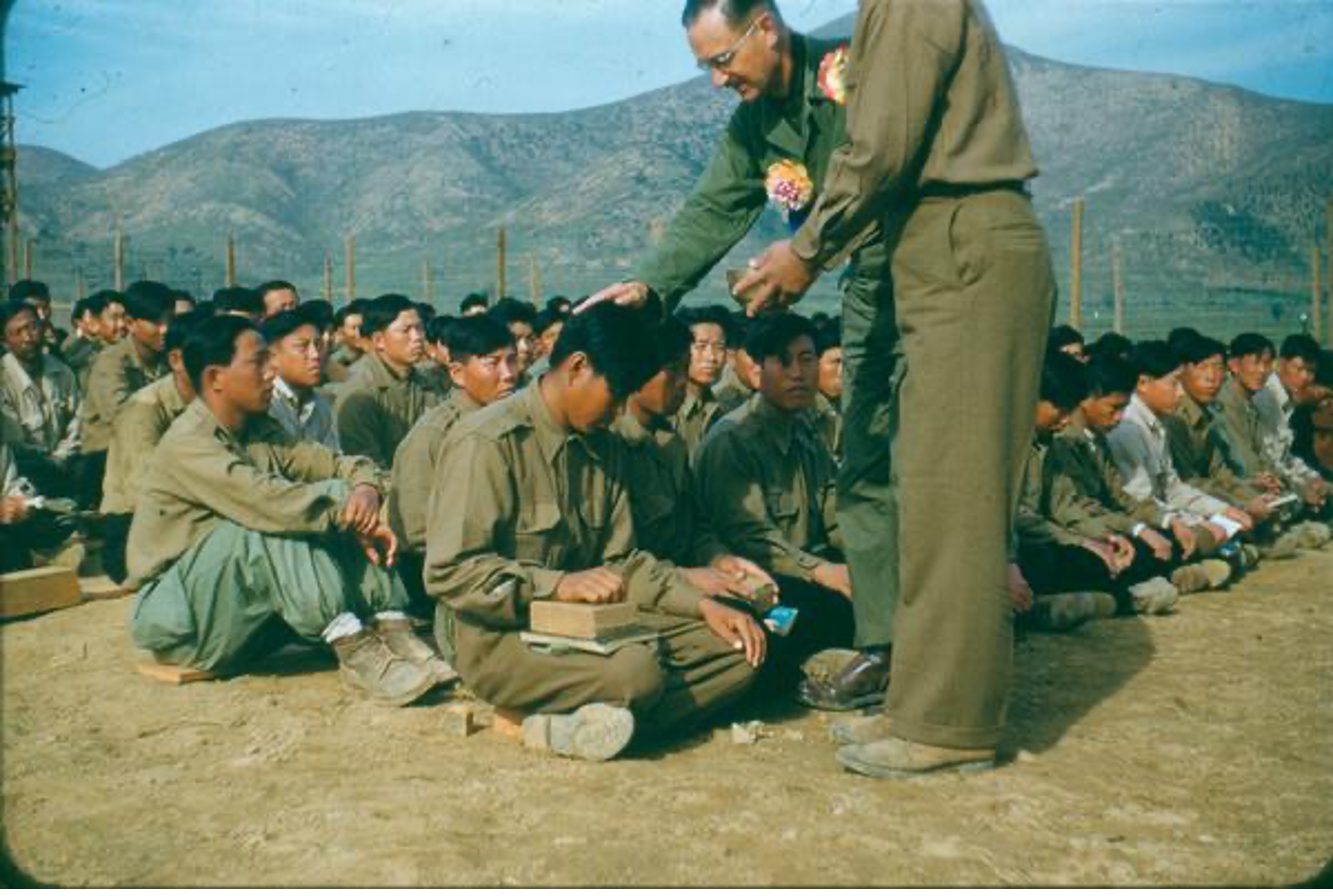
During the Korean War (1950–53), Christian evangelism went behind the barbed wires of the prisoner-of-war camps under the custody of the U.S.-led United Nations Command to convert and transform the captured North Korean enemy into a subject assimilable into “free” South Korea—imagined by transpacific Christian actors as simultaneously Christian and anticommunist. This essay examines the religio-political currents of wartime conversion as a conjoined project: the construction of the body of Christ as coextensive with the Cold War body politic of the US empire, reconfiguring ideas about the relationship between religious conversion and political subjectivity. Drawing on missionary records, media narratives, material objects, and photographs that circulated out of the camps, this essay shows that wartime narratives framed the conversion of North Korean prisoners as not only a moral victory but a flesh-and-blood victory. At the violent crossroads of Cold War empire-making and nation-building, the converted enemy prisoner emerged as a riveting figure whose conversion to Christianity and defection to “free” South Korea materially affirmed that the war against communism in Korea could be won. Situating the coercive conditions of conversion in a longer postcolonial, Cold War—and transimperial—temporality, I argue that the Korean War POW ministry shaped enduring ideas about Christianity as a raw, material weapon for rolling back communism, intensifying the precarity and insecurities for “converted” prisoners seeking political and social belonging on the Cold War peninsula.

This work is licensed under a Creative Commons Attribution-NonCommercial-NoDerivatives 4.0 International License.
Copyright (c) 2026 Transnational Asia